Day 56 - February 16, 2013

We had a great day of work at the hangar, as we progressed closer to completing the TeenFlight 2 RV-12.  There seemed to be an abundance of space in the hangar with the TeenFlight 1 RV-12 gone, so we decided to install the prop and pitot tube figuring (and hoping) that nobody would run into it.


One of the mentors worked on polishing the edges of the rear window.


We made a gasket around the fuel tank fill spout where it meets the fuselage skin to prevent fuel from accidentally leaking into the airplane or onto the rear window.


Many small items still remain to be finished, but we are slowly taking care of them; like safety wiring the fuel strainer.


We installed the bracket and wiring for the ELT (Emergency Location Transmitter).  The ELT is activated when the unit is jarred, and uses the GPS to send the unit's exact location via an emergency frequency to rescuers.  The ELT is used to locate the aircraft if it crashes, and also incorporates a loud horn to help rescuers find the downed airplane. 


This is what happens when shears are used to trim the wing root skin.
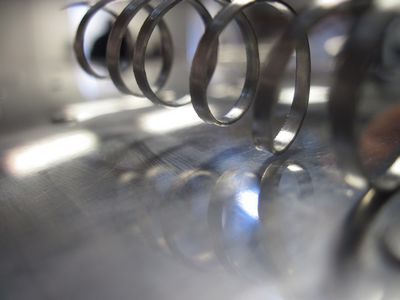

And this is what happens when a very creative student gets her hands on them.


Another item of interest is that a few of the guys from the EAA: Jeff Skiles, Chad Jensen, and Trevor Janz, stopped by to take a look at the project while on their way from McMinville to Seattle. 


Day 55 - February 9, 2013

We completed the service bulletin on the TeenFlight 1 airplane this week.  The last step was to trim the wing root skins to accommodate the extra thickness of the doubler plates on the sides of the fuselage.  There seems to be a lot of space in the hangar now.


One of the students installed the pitch and roll servos for the autopilot.  They are connected directly to the torque tubes for the stabilator and flaperons.
 
(pitch)
 
(roll)


We finished some minor tasks around the airframe like torquing the axle nut for the nosewheel, installing cotter pins on the rudder pedal cable attach spacers, and completing the cabin heat actuator cable.


A mentor spent the day bleeding the brakes.


Day 54 - February 2, 2013


This week, the crew worked mostly on small things around the airplane to help continue progress towards completion.

One of the mentors routed the wires for the interior cockpit light that is mounted to the roll bar.  The wires run through the roll bar and exit out a hole in the bottom of the roll bar and into the main part of the airplane.


A few students finished connecting the throttle cables to the throttle control on the side of each carburetor.  They also installed the choke cables to the choke on each carburetor.  The choke is used for starting the engine, and the throttle is used for, well...going up!


We also installed the headset jacks into the panels next to the seats.


More next week from the TeenFlight crew!

Day 53 - January 26, 2013

After six hours of work on the landing gear service bulletin for the TeenFlight 1 airplane, we got the gear back on and all the bolts torqued down.


On the TeenFlight 2 airplane we continued to route the engine control cables.  They are almost ready to be attached to the carburetors. 


The next step in the lower cowling process was to apply an aluminum heat shield to the inside of the lower cowling half in the places that come close to the hot parts of the engine.  After pressing down the sticky-back of the heatshield to the fiberglass we spread a coat of resin along the edges of the shield to make sure they do not peel up.


We also routed the oil hoses.  That plumbing is almost done except for one hose.


Day 52 - January 19, 2013

After taking off the lower cowling half, we extracted the clecoes from the dried resin and inspected the bonding work.  It set up very nicely and formed a nice thick bond between the cowl half, the cooling duct, and the cooling duct interface.
 

One of the students routed the engine control cables.  They are not hooked up to the engine yet, but are all in place and ready for attaching.


As one of the finishing steps in the control systems, we tightened and verified the tension of the elevator control cables.  In order to adequately set a neutral point for the control stick, the plans called for clamping it to a piece of wood that ran the width of the cockpit.
 
 
We also moved along with progress on the landing gear service bulletin for the TeenFlight 1 airplane.  


Day 51 - January 12, 2013

On Thursday this past week, a couple of the TeenFlight mentors flew the TeenFlight 1 airplane from its current home at the Aurora State Airport to the TeenFlight 2 hangar at the Hillsboro Airport so that we could perform the required surgery on the landing gear to satisfy the latest service bulletin for the RV-12.


So on Saturday, we had two airplanes in the hangar ready for us to work on.
 
In order for the lower cowling half (with the cooling duct attached) to slip into its correct place, the exhaust pipe had to be trimmed to four inches below the cowling.  It dulled out the cutting disc pretty fast, but the sparks were pretty neat.  


 Beginning the service bulletin on the finished airplane was a little different than modifying the partially completed aircraft.  We had to drain the brake lines, and even though we though we could get away without removing the fuel tank, in the end it turned out to be a safer bet to remove it temporarily so that a drill bit did not find its way into it.
 

We also worked all day on the lower cowling cooling duct so that we could epoxy and glass it into the lower cowling half at the end of the day.  As always with fiberglass, it was a messy experience, although the end product looked very nice (when we locked up at the end of the day, the epoxy was still drying so we shall see what the finished product looks like next week).


One of the last steps in completing the exhaust system is to fill the springs with RTV.
 
 
More to come next week from the TeenFlight Crew!


Day 50 - January 5, 2013


After taking a weekend off over the holiday break, we were ready to get back to work!

Our main focus now is the firewall forward section of the airplane.  However a couple of the students went around with a mentor and completed minor tasks to the airframe and its constituent components as to satisfy our "Squawk Sheet".  Besides that, the propeller crew continued making progress on the spinner assembly by using pieces of fiberglass to fill the empty space on the spinner between where the propeller blade root meets the propeller hub and the spinner mounting plate.


We also began fitment of the lower cowling cooling duct which will provide a fresh breeze to the radiator and the oil cooler.


The exhaust system was installed in its spot under the engine.


We changed the brake fluid in the brake lines but were still not able to flush all of the bubbles out of the system.


Some of the students scrubbed the fuel tank with scotch-brite in preperation for a coat of paint.


More next week from the TeenFlight Crew!


Day 49 - December 22, 2012

After mostly finishing up the engine wiring, we moved on to the propeller.  The ground-adjustable, two-blade, composite Sensenich propeller was fitted into its slot on the propeller hub.  Two discs hold on the spinner, and after we attached the propeller, we tested the spinner clearance with the cowling.  We had good clearance with the bottom cowl half, but the top cowl half was just rubbing the spinner.  Later on, we made sure the spinner was on straight, and then we drilled the holes in the spinner attach discs.  


 We attached the stabilator to the tailcone (again) and hooked up the stabilator control cables.
 

Some of the students climbed into the fuselage and finalized the control system by using the plans to go step by step through the section to make sure all of the correct hardware was used in the correct order.  
 
Merry Christmas from the TeenFlight Crew!

Day 48 - December 15, 2012

Airway Science for Kids held a fundraiser-open house at the TeenFlight hangar this week during the latter half of our work day.  Lots of benefactors, donors, parents, and previous mentors showed up to support the program. 

Some of the students began working on the propeller assembly section.  Shown here is the propeller hub where the two propeller halves meet under the spinner.


We drilled holes in the side of the spinner where the propeller blades will protrude.  The aluminum circle next to the spinner is the spinner back plate.


Some more wiring from the firewall to the engine was accomplished before the beginning of the open house as well.  There are only a few more things to be hooked up before we can start working on the exhaust system.